Global Torture Index: Mapping the Risk of Torture for LGBTQIA+ People in Detention

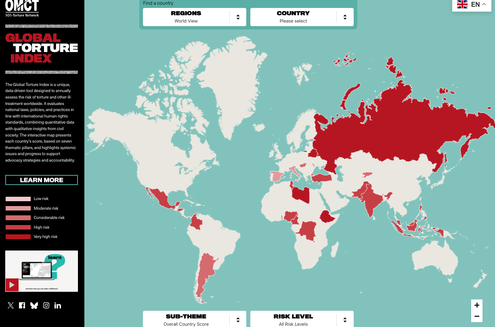
For many LGBTQIA+ people, torture does not begin in detention, it begins with legislation that either criminalises, ignores or fails to protect them. The Global Torture Index, which assessed the risk of torture in 27 countries in 2025, provides a detailed lens through which to examine the situation of LGBTQIA+ persons in detention. In a third of the countries included in its first edition, same-sex relationships are still a crime, and in nearly half, there are reports of harassment and detention by police authorities against homosexual people. In 19 countries, transgender persons have no legal recognition. These legal frameworks do more than legitimise discrimination: they directly shape detention practices in ways that expose individuals to violence, abuse and ill-treatment.
From Discrimination to Torture
Under international human rights law, and in particular Article 1 of the United Nations Convention Against Torture (UN CAT), not all forms of discrimination amount to torture. However, when discrimination is systematic, severe, and is known or omitted by State authorities, it can reach the threshold of cruel, inhuman or degrading treatment, and in some cases, even torture. As recognised by the Committee Against Torture (CAT), State responsibility extends not only to direct acts, but also to failures to prevent foreseeable harm. In this context, legal systems that criminalise same-sex relationships or fail to recognise gender identity do not simply create unequal conditions, they produce institutional practices that expose LGBTQIA+ persons to predictable and disproportionate harm in detention.
Body Violations and Degrading Treatment
In the absence of legal gender recognition, transgender persons are routinely placed in detention facilities that do not correspond to their gender identity. This misclassification directly conditions their treatment and exposure to harm during and beyond initial detention measures.
During the first hours of detention, Index data highlights that individuals may be subjected to invasive body searches that do not respect their gender, often accompanied by misgendering, intrusive questioning, and humiliating practices, with documented cases in countries such as Togo, Nigeria, the Philippines and Tunisia. Access to medical personnel who respect their identity is frequently limited or denied. As a result, detainees may be deprived of appropriate healthcare, including gender-affirming treatment. Beyond initial detention, trans and intersex individuals often face ongoing barriers to accessing gender-affirming and reproductive healthcare, including the lack of hormone therapy and limited or non-existent access to specialised medical care. These barriers result in significant restrictions on bodily autonomy and amount to a disproportionate form of control, directly targeting people’s identity and integrity.
When sustained, these violations can reach the threshold of torture when they become systematic and excessively severe, as they prevent individuals from making decisions over their own body. Index partner organisations in Nigeria and Togo have reported the inadequate medical attention given to LGBTQIA+ detainees, through lack of confidentiality and access to a doctor of choice, often resulting in discriminating and sometimes violent encounters, thereby undermining their self-determination.
Exposure to Violence and State Responsibility
In the 9 countries assessed by the Global Torture Index where same-sex relations are criminalised or heavily stigmatised, LGBTQIA+ persons are not only more likely to be arrested, but also face heightened risks of violence once in detention. This is reflected in numerous concluding observations from the CAT, which has expressed concern about patterns of arrest, detention and ill-treatment linked to sexual orientation or gender identity. In such cases, stigma embedded in legal frameworks is reproduced within these settings, shaping interactions with both authorities and other detainees.
These risks are reflected in practice. In at least four of the observed countries, Index partners reported that LGBTQIA+ deprived of liberty are frequently exposed to verbal harassment, physical abuse, and specifically frequent sexual violence. Trans women held in men’s facilities appear to be particularly at risk.
These patterns are neither incidental nor unforeseeable. Authorities are often, or ought to be, aware of the heightened vulnerability of this group. Yet, in many cases, adequate preventive measures are not taken. This phenomenon increases when the same authorities responsible for protecting detainees are also involved in discriminatory practices, enabling and fomenting discriminating behaviour from other detainees, rather than preventing it. In such contexts, the absence of safe and independent complaint mechanisms reinforces this dynamic. The Index highlights that in around 40% of the countries, complaints must go through the alleged perpetrators, while in over 80% of them partner organisations report little to no access to internal complaint mechanisms or to uncensored communication with external authorities.
Protective Measures
Unfortunately, the harms experienced by LGBTQIA+ detainees are not limited to direct violence. Under the justification of protection, many detention systems place LGBTQIA+ individuals in segregation or solitary confinement, severely restricting their communications and activities.
Transgender and intersex persons, when placed in facilities based on their sex assigned at birth, are often subsequently isolated from the general population for their “safety.” Similarly, individuals perceived as non-heterosexual may be placed in separate units or segregation cells for “protection”. Data collected through the Index and its partner organisations, when made available by State authorities, confirm that such practices are widespread. For example, in Moldova, Tunisia and the Philippines, partners report both a high risk of sexual violence against LGBTQIA+ detainees and the common use of solitary confinement as a so-called protective measure.
When applied automatically, with no regard to individualised assessment, or for prolonged periods, these measures can have severe psychological consequences, including anxiety, depression, and long-term mental health harm. Rather than reducing risk, such measures often exacerbate vulnerability and reinforce marginalisation, translating into severe restrictions on access to basic human rights.
From Invisibility to Accountability
The Global Torture Index sheds light on how the treatment of LGBTQIA+ persons in detention reflects legal systems that criminalise or fail to recognise them, shaping how individuals are classified and treated once deprived of liberty.
These risks are compounded by a lack of transparency. Up to half the countries covered by the Index provide little to no information on key issues such as solitary confinement, classification practices, reproductive rights or access to external contact. This absence of information limits accountability and renders abuses harder to detect and prevent.
Addressing these harms requires both legal and institutional reform. Decriminalising same-sex relations and ensuring legal gender recognition are essential first steps. At the same time, detention systems must adopt safeguards that respect gender identity and avoid harmful practices such as automatic isolation. Strengthening data collection and independent monitoring is critical to ensuring that these violations are no longer invisible.

Join our global movement against torture to help protect human rights defenders worldwide and empower survivors to recover and obtain justice. Consider supporting OMCT and its SOS Torture Network – your donation can make a real difference in promoting human dignity.