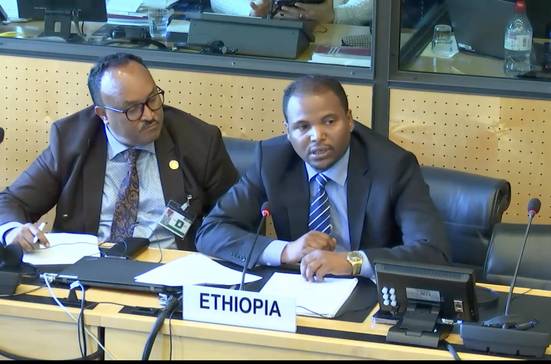
Ethiopia's 7th General Election: Civic Space and Security at Risk
The International Federation for Human Rights (FIDH) and the World Organisation Against Torture (OMCT), under the framework of the Observatory for the Protection of Human Rights Defenders, express serious concern at the environment in which Ethiopia's 7th General Election will be conducted on 1 June 2026. The election will determine the composition of the House of Peoples' Representatives — Ethiopia's 547-seat lower chamber of Parliament — whose members, once elected, will determine the formation of the government, including the election of the Prime Minister from among their ranks.
28 May 2026. The Ethiopian Government must take concrete steps, in the immediate term and over the longer term, to protect human rights defenders, restore civic space, and ensure an electoral environment consistent with Ethiopia's own Constitution and international human rights obligations. An electoral process cannot be considered credible, free or fair in a country where human rights defenders (HRDs) face systematic targeting, civil society organisations operate under the threat of suspension and dissolution, independent journalists work in a climate of fear, and armed conflict continues in multiple regions with little accountability.
The Repression of Human Rights Defenders
When Prime Minister Abiy Ahmed came to power in 2018, Ethiopia's human rights community hoped that a genuine democratic opening had arrived. Those hopes have been significantly undermined. The Observatory's December 2025 report, "The Illusion of Progress: Ethiopia's Human Rights Defenders Under Attack", based on 41 documented cases between 2020 and 2025, found that "violations reminiscent of pre-2018 repression have returned with greater intensity". Seven HRDs in the documented cases suffered torture; four were subjected to enforced disappearance. More than 50 journalists and defenders have fled into exile. The re-emergence of the notorious Awash Arba military camp as a site of secret detention and torture is a deeply troubling development that recalls practices the country had appeared to move beyond.
Since late 2024, the Authority for Civil Society Organizations (ACSO) suspended at least five major organisations, including the Ethiopian Human Rights Defenders Center (EHRDC), Center for Advancement of Rights & Democracy (CARD), Association of Human Rights in Ethiopia (AHRE), Ethiopian Human Rights Council (EHRCO) and Lawyers for Human Rights (LHR). While the suspensions were lifted in March 2025 following intense advocacy efforts, the episode underlined the fragility of civil society's operating environment and the ease with which organisations can be targeted on vague grounds. Earlier in 2024, over 1,500 CSOs were dissolved for administrative non-compliance. A proposed new CSO law drafted in mid-2025 — still pending as of the date of this statement and not yet tabled in parliament — would further constrain independent civil society by placing governance under direct state control, banning international advocacy funding, granting the Ministry of Justice broad power to dissolve organisations, and eliminating judicial appeal. These are structural issues that require sustained engagement and legislative reform over the coming period.
Ethiopia ranked 145th out of 180 countries in Reporters Without Borders' (RSF) 2025 Press Freedom Index, with eight journalists currently imprisoned. Ethiopian security forces arrested at least six journalists in August–September 2025 alone. In February 2026, authorities revoked Reuters journalists' accreditation following a critical investigative report. At the 61st session of the UN Human Rights Council in March 2026, 41 countries issued a joint statement warning that "full respect for civil and political rights and a free civil society and media environment are preconditions for free and fair elections," urging Ethiopia to "reverse the current negative trend".
Elections in a Context of Conflict and Impunity
Ethiopia's June 2026 elections - the first since the armed conflict broke out in Tigray in 2020 - take place against the backdrop of ongoing armed conflict in Amhara and Oromia, where federal forces, Fano militias, and the Oromo Liberation Army have all been implicated in serious human rights abuses. As of December 2025, UNHCR recorded approximately 1.9 million internally displaced persons in Ethiopia, with ongoing conflict continuing to drive new displacement into 2026. Ensuring that citizens in conflict-affected areas can participate meaningfully in the electoral process remains a significant and unresolved challenge.
The transitional justice process remains at an early stage. While the government adopted a transitional justice policy in April 2024 and finalised an implementation roadmap by August 2024, the key institutions it foresees — including a truth and reconciliation commission, special prosecutor bench, and reparations fund — have not yet been operationalised. No meaningful accountability has been pursued for crimes committed during the Tigray conflict. Ten major opposition parties publicly declared in November 2025 that there was "no foundation whatsoever for democratic process in the country" and outlined fundamental preconditions for electoral participation, including the release of political prisoners, an end to armed conflict, and guarantees of freedom of assembly. As recently as January 2026, further opposition groupings warned that the candidate registration process lacked transparency and that political parties continued to face "politically motivated administrative barriers" to participation.
Recommendations
We urge the Ethiopian Government to:
- Release all arbitrarily detained HRDs, journalists, and opposition members who are held for the peaceful exercise of their rights, as an immediate priority ahead of and following the elections;
- Withdraw the proposed draft CSO proclamation and initiate a genuine, inclusive consultation process with civil society before any new legislation is adopted;
- Ensure that the reversal of civil society suspensions in March 2025 marks a genuine and durable change in practice, not a temporary reprieve; refrain from using administrative mechanisms to suspend or dissolve organisations on political or vaguely defined grounds; and guarantee that all future decisions affecting CSOs are subject to transparent criteria and independent judicial oversight;
- Ensure that all detainees, including those in military facilities, have immediate access to legal counsel and family members, and investigate credible reports of torture and ill-treatment at detention sites;
- End the harassment of journalists, restore accreditations revoked on political grounds, review the April 2025 media law amendments, and ensure equal media access for all political parties during and after the electoral period;
- Guarantee access for domestic and international election observers — including in conflict-affected zones in Amhara, Oromia, and Tigray — and uphold the independence of the National Electoral Board of Ethiopia (NEBE);
- Ensure that security forces are not deployed for political intimidation, and that all citizens and parties can campaign and assemble freely and peacefully;
- Commit to a credible implementation timeline for the 2024 transitional justice policy, with adequate resources and independence for its proposed mechanisms.
We call on the International Community to:
- Engage Ethiopia on the need for concrete, sustained improvements in the protection of HRDs, freedom of expression, and civic space, including pressing for the withdrawal of the proposed restrictive CSO law;
- Deploy independent election observation missions[1] — including to conflict-affected areas — and report findings transparently, noting that only IGAD has announced an observation mission as of the date of this statement;
- Continue to raise documented patterns of repression at multilateral forums and support sustained UN Human Rights Council monitoring of the human rights situation in Ethiopia;
- Encourage Ethiopia to implement recommendations from its Universal Periodic Review relating to freedom of expression, association, and the protection of human rights defenders;
- Support full implementation of the Pretoria Agreement as the framework for peace in northern Ethiopia, and encourage all parties to resolve outstanding disputes through dialogue rather than armed confrontation.
Meaningful democracy requires more than elections — it depends on the existence of an open civic space in which human rights defenders, civil society organisations, and the media can operate without fear of reprisals. The Observatory recognises that many of the structural challenges documented in this statement are long-term in nature and will require sustained political will and sustained engagement by all actors. However, some measures — releasing those detained for peaceful advocacy, guaranteeing observer access, and ensuring freedom of assembly during the campaign — are within the government's immediate capacity and should be acted upon without delay. The Observatory will continue to monitor the situation and stands in solidarity with Ethiopia's human rights defenders.
Tags
Related resources
-
- Ethiopia
- 02.07.25
- Statements
 Read more
Ethiopia: New Draft Law Threatens to Dismantle Civil Society