Strengthening the Collective Response to Human Rights Defenders’ Arbitrary Detention
Across every region, human rights defenders (HRDs) continue to be arbitrarily detained for their work, sometimes for days, sometimes for years. As underscored by the UN Special Rapporteur on the Situation of Human Rights Defenders, Mary Lawlor, who OMCT spoke with in our latest interview, in her landmark report States in Denial (2021), long-term detention is increasingly used to dismantle civil society movements, crush hope, and inflict lasting psychological and physical harm. Short-term detention, meanwhile, remains a tool of intimidation, designed to disrupt activism, spread fear, and signal state power.
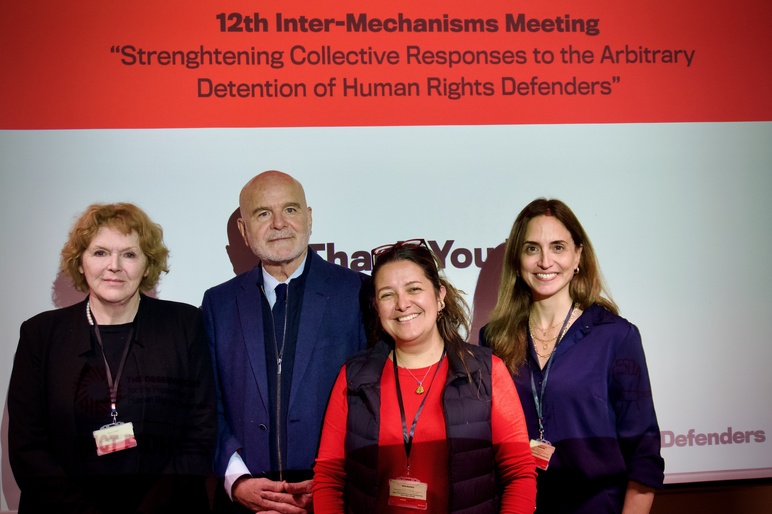
This year, within the OMCT–FIDH Observatory partnership, the 12th Inter-Mechanisms Meeting (IMM) brought together UN and regional mandate holders, civil society organisations, and European Human Rights Ambassadors to strengthen collective responses to this global pattern. The conversations made one thing clear: no mechanism alone can match the sophistication and persistence of state repression, but together, coordinated action can shift outcomes.
Short-term vs long-term detention: why both matter
Participants stressed that while short-term detentions rarely make headlines, they form the backbone of daily repression, creating constant risk, draining resources, and targeting whole communities. Long-term detentions, by contrast, are designed to break defenders and cripple movements. Both forms require different strategies: rapid alerts and immediate diplomatic engagement for short-term cases; sustained advocacy, family-centred support, and coordinated pressure for long-term ones.
What the IMM delivered
Over two days of closed-door exchanges, participants committed to take concrete, coordinated action for the release of HRDs arbitrarily detained:
- States committed to engage in coordinated diplomacy, to observe trials against HRDs criminalised for their legitimate work, and to follow-up with national authorities responsible for their arbitrary detention.
- Both mandate holders and states committed to enabling better access to HRDs arbitrarily detained, to share information on their detention conditions, and to align advocacy efforts for their release.
Participants also agreed on the following objectives to counter the increasing criminalisation of legitimate human rights work:
- Raising the cost of detention through targeted pressure, visibility, and engagement with institutions that influence governments.
- Adapting to restricted civic space. When access closes, visibility and international action become essential.
- Strengthening alliances across mechanisms, regions, NGOs, diplomats, community and families, because no actor alone can match the scale of repression. Collective pressure works.
The meeting culminated in a joint statement by mandate holders, a powerful signal that calls for concerted global action to secure the release and protection of detained human rights defenders.
Looking ahead
The IMM reaffirmed that arbitrary detention is not inevitable; it is a choice by states, and it can be countered. The commitments made in Brussels mark an important step toward a more coordinated, sustained, and visible response. As one participant put it: “Every release begins with a collective decision not to give up.”