Niger: Activist and regional symbol for peaceful resistance imprisoned for standing up to governments
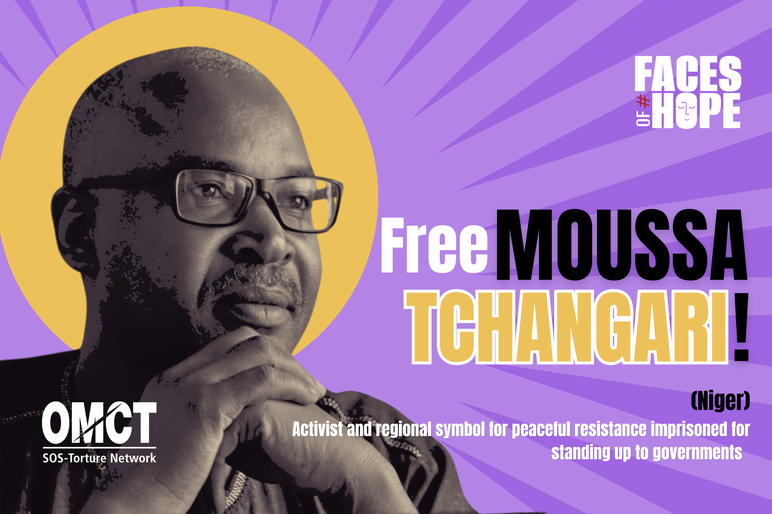
Moussa Tchangari, human rights defender widely recognized as a leading voice for the Nigerien people's demands for democracy, security, resource sovereignty, and independence, was arbitrarily arrested on 3 December 2024, for expressing critical views of the ruling authorities. That same day, Moussa Tchangari was remanded in custody at Filingué prison, 170 kilometers from Niamey, where he remains arbitrarily detained pending trial. If convicted of conspiracy and intelligence with foreign powers, he faces the death penalty.
A lifetime of civic engagement
Moussa Tchangari is a prominent journalist and General Secretary of Alternative Espaces Citoyens (AEC), one of Niger's most important civil society organizations and member of OMCT working group on migration and torture since 2019.
His journey as a human rights defender began in the 1990s, during a time of political upheaval. As a student leader with the Union of Nigerian Students (UNS), he campaigned fearlessly for democratization alongside worker unions. In 1991, he co-founded the Nigerian Association for Human Rights (ANDDH), the first human rights organisation in Niger. His voice grew louder in the years that followed, especially through journalism, as he has played a critical role in defending the rights of migrants who cross Niger as a transit country to Europe.
Through his work, Moussa Tchangari has become a regional symbol of peaceful resistance. He has courageously criticized government policies on insecurity, military overreach, and shrinking civic space across the Sahel region. He advocates not only for political freedoms, but also for resource sovereignty, the rule of law, and the right of civil society to operate independently. His reputation earned him respect as a role model for human rights defenders across West Africa.
A coup and a crackdown
On 26 July 2023, Niger underwent a political rupture when the Presidential Guard staged a coup d’état and detained President Mohamed Bazoum. General Abdourahamane Tchiani declared himself the leader of a new military junta, launching a repressive era marked by cracked down on opposition, media, and peaceful dissent.
Authorities have increasingly suppressed independent voices, arbitrarily arresting human rights defenders, journalists, and political critics. Coup leaders have banned demonstrations by civil society organisations and opposition political parties and violently dispersed peaceful protesters, violating citizens' rights to peacefully assemble.
The Nigerien military-led authorities have failed to uphold their commitment to respect human rights and protect civil liberties, implementing a systematic clampdown on former regime officials and critical voices. This broader crackdown underscores the rising risks faced by civil society actors such as Moussa Tchangari, as dissent is met with repression rather than dialogue.
The night they came for him
On 3 December 2024, Moussa Tchangari was arrested at his home in Niamey, Niger's capital, by at least three gunmen in plain clothes who claimed to be policemen. They seized his phone, laptop, and suitcase, hooded him, and took him away. When he asked for a warrant, they dismissed the need for one. The arrest occurred upon his return from Abuja, Nigeria, with security operatives surrounding his house and preventing access before taking him to an unknown destination.
His fate and whereabouts were unknown for two days until 5 December 2024, when he was located at the Central Service for Combating Terrorism and Organised Transnational Crime in Niamey. On 3 January 2025, the Niamey High Court charged him with several severe offences: “criminal conspiracy in connection with a terrorist enterprise,” “undermining national defence,” “plotting against the authority of the state through intelligence with enemy powers,” as well as additional charges such as “infringing on national defence” and “intelligence with enemy countries”. If convicted, he could face 5–10 years in prison, or even the death penalty on the most serious charge
This is not Moussa Tchangari's first arrest - he was previously detained in 2015 for 10 days in the anti-terrorist Brigade in Niamey after giving an interview to Radio France Internationale about traditional chiefs detained in the Diffa region. He was charged with undermining national defense, a capital offense under Niger legislation, before being provisionally released. He has been repeatedly targeted for being a critical voice against the military junta in power and for previously denouncing humanitarian situations in areas attacked by Boko Haram.
Harsh prison conditions and isolation
Moussa Tchangari is currently held in pretrial detention at Filingué Prison, approximately 170–180 km from Niamey, following his formal charging in January 2025. This remote location makes access to legal representation and family visits particularly difficult.
His detention follows a pattern of arbitrary arrests and harsh treatment of civil society activists in Niger since the military coup. The prolonged nature of his detention raises serious concerns about due process and fair trial guarantees under international human rights standards.
Global calls for his release
International organisations—including Amnesty International, Human Rights Watch, the International Federation for Human Rights (FIDH), and the World Organisation Against Torture (OMCT)—condemn the lack of transparency, denounce the continued pretrial detention, and assert that the charges serve primarily to silence his human rights advocacy
Authorities have provided no justification for his continued detention under vaguely defined national security laws. His lawyers' attempts to challenge jurisdiction and nullify the case have thus far been rejected by Nigerien courts, with appeals currently pending. Human rights groups continue to demand his immediate release and urge the regime to drop all charges.
More than an activist
Beyond his activism, Moussa Tchangari is known to be deeply invested in civic education and community engagement, often through radio programming and public dialogue. He has previously taught a human rights course at the Niamey Police Academy and participated in regional seminars on democratic governance and humanitarian action across West Africa, including Nigeria and Côte d’Ivoire. His longstanding commitment to peaceful, citizen-centered reform demonstrates not just his professional activism but his personal dedication to a democratic Niger.
Please, join us in calling for the release of Moussa Tchangari!
Tags
Related resources
-
- 07.05.20
- Statements
 Read more
Human Rights Defenders Imprisoned Worldwide #FacesofHope