COP30: Defend Indigenous Peoples & Protest Rights
To: Mr. Simon Stiell
Executive Secretary of the United Nations Framework Convention on Climate Change (UNFCCC)
CC:
Ms. Christine Adam (Director and Principal Legal Adviser, UNFCCC) Ms. Elisa Morgera (UN Special Rapporteur on the promotion and protection of human rights in the context of climate change), Ms. Astrid Puentes Riaño (UN Special Rapporteur on the human right to a clean, healthy and sustainable environment), Dr. Albert K. Barume (UN Special Rapporteur on the rights of Indigenous Peoples),
Belém, 17 November 2025
Dear Mr. Stiell,
The undersigned organizations are writing to express our utmost concern about your letter to the Government of the Federative Republic of Brazil, dated 12 November 2025 (reference: EC-2025-263), and to urge you to take immediate steps to reverse the negative consequences of this letter on human rights, in particular of Indigenous Peoples, Environmental and Human Rights Defenders, and of those wishing to exercise their right to peaceful protest.
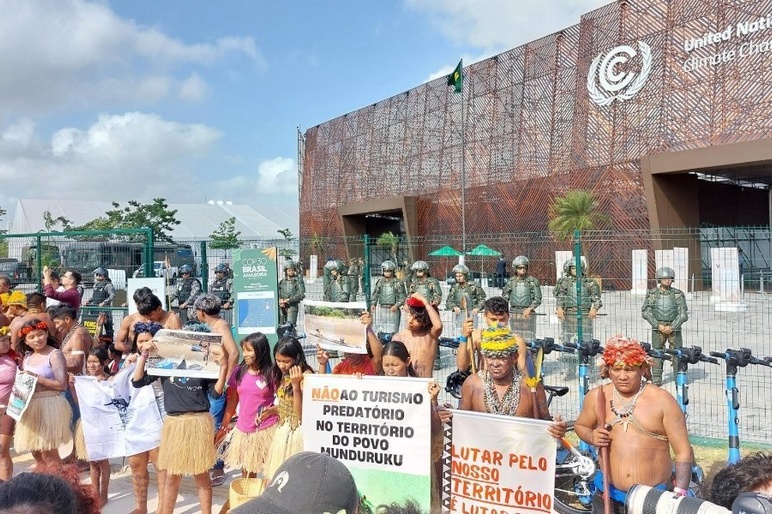
Following a “security incident” at the COP30 venue last week, this letter urges the Brazilian Presidency to step up the presence of uniformed security forces around the COP30 venue and to intervene to disperse protests. In doing so, the letter contributes to an increasing global trend towards the silencing of dissent, militarized response to protest, and marginalization of those defending land and the environment, including the Indigenous Peoples of the Brazilian Amazon. The consequence of the letter has been a massive escalation of security force presence in and around COP30, creating a chilling effect and a feeling of unsafety for Indigenous Peoples, Environmental and other Human Rights Defenders, civil society, and activists standing up for their rights.
Indigenous Peoples defending and demanding legal recognition of their land and their right to self-determination, and protecting our ecosystems and planet, are not a threat. Indigenous women with children demanding access to the negotiations that are determining their future, are not a threat. Such demonstrations are not acts of disruption but expressions of Indigenous Peoples’ collective political will, grounded in their self-governance systems, cultural traditions, and worldviews. Threatening is the massive presence of security forces, especially in a global context of growing violence against environmental defenders, including in the host country. A statement issued by the International Indigenous Peoples Forum on Climate Change (IIPFCC) in response to Tuesday’s events at the COP30 venue points out that this escalation “is replicating the form of state violence Indigenous Peoples and human rights defenders face across our territories.”
The United Nations Framework Convention on Climate Change (UNFCCC) Secretariat has legal obligations to uphold all human rights, under customary and treaty law, including the rights to freedom of peaceful assembly and expression, which are intrinsic to democratic societies. Rather than undermining the right to peaceful protest of defenders calling for climate action – upholding the objectives of this very convention – the UNFCCC Secretariat should recognize how the monumental presence of Indigenous Peoples in the city of Belém, and the ability of all to have their voices heard in its streets, is conducive to more ambitious outcomes, socially beneficial responses, and greater accountability at this climate summit. This is a power that the process has lacked at COP27, COP28, and COP29, due to the heavy restrictions on the exercise of human rights in the respective host countries. In this context, civil society has been urging the UNFCCC to take proactive steps to ensure that host countries commit to upholding human rights in the context of climate summits, including through its host country agreement. This letter does the opposite.
The United Nations Framework Convention on Climate Change (UNFCCC) Secretariat has legal obligations to uphold all human rights, under customary and treaty law, including the rights to freedom of peaceful assembly and expression, which are intrinsic to democratic societies. Rather than undermining the right to peaceful protest of defenders calling for climate action – upholding the objectives of this very convention – the UNFCCC Secretariat should recognize how the monumental presence of Indigenous Peoples in the city of Belém, and the ability of all to have their voices heard in its streets, is conducive to more ambitious outcomes, socially beneficial responses, and greater accountability at this climate summit. This is a power that the process has lacked at COP27, COP28, and COP29, due to the heavy restrictions on the exercise of human rights in the respective host countries. In this context, civil society has been urging the UNFCCC to take proactive steps to ensure that host countries commit to upholding human rights in the context of climate summits, including through its host country agreement. This letter does the opposite.
Beyond the immediate situation in Belém, the most consequential impact of your letter is the precedent it sets. Even if the Brazilian government chooses not to escalate repression, your letter risks granting a broad and permissive mandate to future COP presidencies that may not exercise the same restraint. It risks signaling that expansive security responses to peaceful protest are acceptable within the UNFCCC context, and it invites future hosts to curtail fundamental rights under the cover of institutional endorsement. This would entrench a trajectory that places human rights defenders - in particular women and Indigenous Peoples advocates - at even greater risk at climate summits for years to come.
We urge you to issue a public statement at the start of week 2 to reverse the negative consequences of this letter - including by requesting the host country to reduce the presence of security forces in the vicinity of the COP30 venue and the city of Belém as a whole - to acknowledge the role of Indigenous Peoples in preserving our environment, their central role in maintaining climate balance and to commit to upholding their rights, and the rights of all to peacefully protest at this COP and any future UNFCCC meetings.
We remain at your disposal should you have any questions.
Signatory organisations:
- 350.org
- A Wisdom Keepers delegation & Confederación Nacional de Comunidades Afectadas por Mineria e Hidrocarburos (CONACAMHI)
- AbibiNsroma Foundation
- Abogadas y Abogados del Noroeste Argentino en Derechos Humanos y Estudios Sociales (ANDHES)
- ACE Observatory
- African Women’s Development & Communication Network (FEMNET)
- Akina Mama wa Afrika
- Alliance of Global Volunteer Organizations (AGVO)
- Alliance of Nurses for Healthy Environments
- Amnesty International
- Arid Lands Action Forum
- Asia Pacific Network of Environmental Defenders
- Asian People’s Movement on Debt and Development
- Association for Farmers Rights Defense (AFRD)
- Association of Women of Southern Europe AFEM
- Association québécoise des organismes de coopération internationale (AQOCI)
- Attac France
- AZ AANHPI Advocates
- Bangladesh Food Security Network- Khani
- Bargny Coast Waterkeeper
- Barokupot Ganochetona Foundation-BGF
- cambiaMO
- Campaign of Campaigns
- Canadian Association for the Club of Rome (CACOR)
- Canadian Association of Physicians for the Environment
- Canadian Interfaith Fast For the Climate
- Canopy
- Casa Rio Lab
- Center for Biological Diversity
- Center for International Environmental Law (CIEL)
- Centre for Economic and Social Rights (CESR)
- Centre for Research and Advocacy, Manipur
- Centro de Estudios Legales y Sociales (CELS)
- Centro de Intercambio Sub Regional Cono Sur Alahua (CISCSA)
- CEUS Chile
- Chikka Federation of India
- Child Rights International Network (CRIN)
- Climate Action and Response Alliance Kenya
- Climate Action Network - Réseau action climat Canada
- Climate Action Network Australia
- Climate Action Network International
- Climate Action Network US
- Climate Action Network Zimbabwe
- Climate Activist Defenders
- Climate and Health Alliance
- Climate Bridges
- Climate Clock DRC
- Climate Justice Alliance
- Climate Rangers
- Climate Rights International
- CliMates France
- CliMates International
- Coaltion des Volontaires pour la Paix et le Développement (CVPD)
- Colectivo de Coordinación de Acciones Socio Ambientales (Colectivo CASA)
- Collectif Femmes pour le Climat
- Common Threads Indigenous Peoples Organisation
- Community Action For Health and Development (CAHED)
- Conectas Direitos Humanos
- Confédération des syndicats nationaux CSN
- CooperAccion
- Corporate Accountability
- Corporate Europe Observatory
- Crimean Tatar Resource Center
- CSMBU*
- Dalit with Disabilities Association Nepal
- David Suzuki Foundation
- Debt for Climate
- Dejusticia - Centro de Estudios de Derecho, Justicia y Sociedad
- Dibeen for Environmental Development
- Digo Bikas Institute
- Disability Peoples Forum Uganda
- Disability Rights Fund
- Downtown Crenshaw Rising
- Dukingire Isi Yacu
- Earth in Brackets
- Earthrise Collective
- EcoEquity
- Ecojustice Ireland
- Ecologistas en Acción
- Emonyo Yefwe International
- End Fossil Occupy Uganda
- Enda Colombia
- Equal right
- Equidad de Género: Ciudadanía, Trabajo y Familia
- European Center for Constitutional and Human Rights (ECCHR)
- Extinction Rebellion Italia
- Extinctionrebellion Essen
- Extinctionrebellion Germany
- Extinctionrebellion NRW+
- Faith for the Climate
- Faudar Rural Educational Society for Harijans
- Feminature Uganda
- FIAN Belgium
- FIAN Brasil
- FIAN International
- FIAN Zambia
- Fondation Internationale pour le Développement, l'Éducation, l'Entreprenariat et la Protection de l'Environnement (FIDEPE)
- Forum des femmes Autocthones du cameroun (FFAC)
- Foundation for the Conservation of the Earth (FOCONE)
- Fridays For Future Africa
- Fridays for Future USA
- Friends of Franbarnie International (FOFI)
- Friends of the Earth England, Wales & Northern Ireland
- Friends of the Earth Europe
- Friends of the Earth International
- Friends of the Earth Netherlands, Milieudefensie
- Fundacion Hampi Maki de Sanadores Ansestrales dl Perù
- GenDev Centre for Research and Innovation India
- GenerationUs Kenya
- Girl up caribbean
- Girl up Chikka
- Global Initiative for Economic, Social and Cultural Rights
- Global Witness
- Grassroots Global Justice Alliance
- Green Africa Network
- groundWork - Friends of the Earth South Africa
- Habitat Defenders Africa (HDA)
- Habitat International Coalition
- Hawai’i Institute for Human Rights
- Hawkmoth
- Heinrich Böll Stiftung
- Hope for Change Women Network
- Human Power Organisation
- HURIES consortium
- ICCA consortium
- Indigenous Environmental Network
- Indigenous Peoples of the Coastal Bend
- Iniciativas para el Desarrollo de la Mujer Oaxaqueña (IDEMO)
- Interamerican Association for Environmental Defense (AIDA)
- International Federation for Human Rights (FIDH), in the framework of the Observatory for the Protection of Human Rights Defenders
- International Indian Treaty Council
- International Service for Human Rights
- International Student Environmental Coalition
- International Trade Union Confederation (ITUC)
- International Women’s Development Agency (IWDA)
- Inuit Circumpolar Council
- Jubilee Australia Research Centre
- Just Transition Alliance
- Klimadelegation e.V
- L'Associació pels Drets Sexuals i Reproductius
- La Ruta del Clima
- Land is Life
- Latinamerican and Caribbean WGC
- Legal Rights and Natural Resources Center
- Legal Rights and Natural Resources Center
- Lexington Climate Action Network (LexCAN US)
- LIFE Education SUstainability Equality
- Life of Pachamama
- Ligue française des droits de l'Homme (LDH)
- Loretto at the UN
- Lumière Synergie pour le Développement
- Manifestation. Alternatif France
- MAUSAM
- Medico International
- MenaFem Movement
- Michigan Anishinaabek Caucus
- Michigan Environmental Justice Coalition
- Micronesia Climate Change Alliance
- Minority Rights Group International
- Mission inclusion
- Mobilisation 6600 Parc-Nature MHM
- Movement Rights
- Namati
- Natural Justice
- NATURELCD
- NON à une marée noire dans le Saint-Laurent
- North Eastern Wildlife Conservancies Associations (NECA)
- Nour
- Nuclear Information and Resource Service
- Observatori DESCA
- Oil Change International
- Oxfam
- Palestinian Institute for Climate Strategy (PICS)
- Parents for Future Bonn
- Participatory Research & Action Network (PRAAN)
- Power Shift Africa
- Pueblo Action Alliance
- Quaker United Nations Office Geneva
- Quaker United Nations Office NY
- Re Earth Initiative
- Reacción Climática Bolivia
- ReCommon
- Red de Acción por los Derechos Ambientales (RADA)
- Red de Comunidades Afectadas por IFIs
- Red Nacional de Mujeres en Defensa de la Madre Tierra (RENAMAT)
- Réseau d'appui et de Promotion des Aires du Patrimoine Authoctone et Communautaire du Cameroun (RAPACAM)
- Resilient40
- Sansristi
- Sauti Salama
- Sengwer Indigenous Community Trust
- Shifting the Power Coalition
- Sinatsisa Lubombo Women and girls Empowerment organization
- Society for orphan, neglected and youths
- Solidaritas Perempuan (Women's Solidarity for Human Rights) Indonesia
- Solidarity Health Foundation
- Somali Environmental Development Organization (SEDO)
- SOMO
- Stand.earth
- Sukaar Welfare Organization
- SustainUS
- The Callegory
- The Global Sunrise Project
- The Woven Project
- Tikna’oj
- Tipping Point North South
- Trócaire
- Tsikini
- UCIZONI
- UK Youth Climate Coalition
- Vigilance OGM
- Wapichan Wiizi Women's Movement
- War on Want
- Waste Or Create Hub
- WECF International
- Women Enabled International
- Women’s Earth and Climate Action Network (WECAN)
- Women's International League for Peace and Freedom (WILPF)
- World Animal Protection
- World Organisation Against Torture (OMCT), in the framework of the Observatory for the Protection of Human Rights Defenders
- World's Youth for Climate Justice
- Young Indigenous Women Action
- YOUNGO children and youth constituency of the UNFCCC
- YOUNGO working group on Just Transition (JTWG)
- Youth and Environment Europe
- Youth Coalition for Sexual and Reproductive Rights