Defending Human Rights in Ecuador
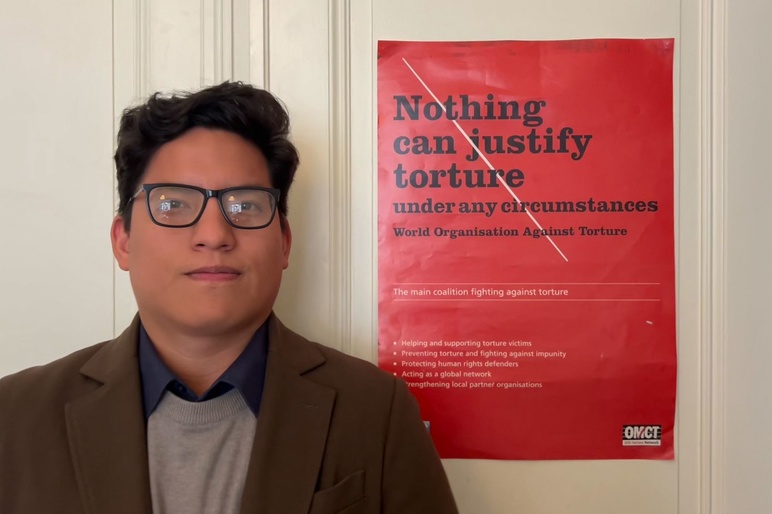
Fernando Bastias is a lawyer and human rights defender for the Permanent Committee for the Defense of Human Rights (CDH Guayaquil), and a member of the Group of Litigators against Torture in Latin America of the World Organisation Against Torture (OMCT). From a young age, he committed himself to human rights work as a lawyer, using legal methods to assist victims. His inspiration stems from those who defend human rights without claiming to be human rights defenders; families of people deprived of liberty, community leaders, and victims seeking human conditions. During his visit to Brussels for the EU Human Rights Forum, he shared insights on the concerning human rights conditions in Ecuador.
What is the current human rights situation in Ecuador?
Ecuador is going through a critical moment. Repression, excessive use of force against protesters, and arbitrary detentions are realities that affect us all, especially those of us who raise our voices for justice. There are narratives and legislative actions that seek to limit the exercise of rights, as well as the work of human rights defenders and civil society organisations. Judicial independence is also at risk from political pressure that undermines its autonomy.
We are living under a state of emergency that has limited fundamental rights and facilitated the deployment of the armed forces on the streets. Serious human rights violations are occurring, such as in the case of Las Malvinas, where 16 military personnel were recently found guilty of the forced disappearance and murder of four minors. Added to this crisis is the violence of organised crime, which results in homicides and territorial control, seriously affecting the security and daily life of individuals and their communities.
What obstacles prevent the effective protection of human rights in Ecuador, and what can be done about them?
Beyond specific violations, the most worrying trend is the construction of narratives that seek to legitimise them. When society begins to tolerate torture, extrajudicial executions or the denial of rights in the name of security, the risk is profound. In response to this, the defense of human rights cannot be limited to litigation and judicial decisions. Without grassroots' work and social education, even the most important legal victories can be put at risk by a lack of social support.
The challenge is to rebuild a culture of peace from the bottom up, in the territories, by listening to the realities of people affected by violence. Defending human rights requires understanding fears, combating narratives, speaking honestly, grounding oneself in reality, and sustaining the struggle even in contexts of extreme violence.
In your work with people deprived of their liberty, what human rights violations do you observe and why do they persist?
The social rehabilitation system in Ecuador is deeply obsolete. The way society deals with transgressions is by sending people to prison under the idea of “rehabilitation” or “reintegration”, a model that in practice fails due to its structure and limitations. Prison continues to be an instrument that systematically reproduces social exclusion and violations. This penal logic not only impacts those deprived of their liberty, but also their families, especially women, who face stigmatisation, fear and precariousness.
Added to this are conditions of detention that constitute grave human rights violations: torture, ill-treatment, denial of medical care, overcrowding and control of the prison population through institutional violence. The prison massacres in Guayaquil highlights the fragility of the system and its inability to guarantee the safety and dignity of those deprived of their liberty.
Given the current context, how can we protect ourselves as human rights defenders, as well as the victims and their families?
Accompanying victims of human rights violations is not just about filing lawsuits; it is about being with them, listening to their pain and supporting their struggle. Each new case is a new challenge, and as organisations and human rights defenders we face emotional exhaustion, financial constraints, an increase in cases and a lack of capacity to respond to an ever-growing number of violations. This can cause frustration, especially when families need immediate answers to situations that can take years to resolve, such as enforced disappearances or cases of institutional violence. However, we try to balance conviction with self-care so as not to burn out.
Defending victims and their families means listening to them, involving them in the processes, validating their experiences, and recognising their fears and suffering. It is a work of patience, strategy, care, and constant accompaniment, where every small step forward counts and where justice is built together, step by step, with respect, humanity and deep commitment.
What message of hope would you like to share?
I hope that this historic fight for human rights does not end with me. This is where I find meaning in my work. The important thing is to act and accompany those who suffer, the victims who await justice, who continue to fight for their children to appear, even when the pain is great, and the institutions fail; they are still there, and that is why we must continue.
When systems collapse, and there are no resources or political support, the best ideas arise from the real needs of the people. We cannot rely solely on what has already been built or assume it will work on its own; we must return to the territories, listen to the communities, learn from their experiences, and rebuild from the bottom up. We have a responsibility to sustain what works and transform what is failing, without fear, defending human rights as far as we can.