Hungary: Criminal prosecution of Mr Géza Buzás-Hábel for promoting LGBTQIA+ rights
HUN 001 / 0226 / OBS 011
Criminalisation /
Obstacles of freedom of assembly
Hungary
19 February 2026
The Observatory for the Protection of Human Rights Defenders, a partnership of the International Federation for Human Rights (FIDH) and the World Organisation Against Torture (OMCT), requests your urgent intervention in the following situation in Hungary.
Description of the situation:
The Observatory has been informed about the prosecution of Mr Géza Buzás-Hábel, Hungarian human rights defender, teacher, and organiser of the 2025 Pécs Pride, in the south of Hungary. Mr Buzás-Hábel is also the co-founder and director of the Diverse Youth Network, a non-governemental organisation promoting equality, inclusion, and the rights of LGBTQIA+ persons.
On 9 February 2026, the Pécs District Prosecutor’s Office formally informed Mr Buzás-Hábel that criminal charges under Article 217/C of the Hungarian Criminal Code had been brought against him for organising the 2025 Pécs Pride. The charges relate to the offence of “organising a prohibited assembly”, an offence punishable by up to one year of imprisonment under Hungary’s Penal Code, which criminalises the organisation of public assemblies banned by police. The case has now been referred to the Pécs District Court. If convicted, Mr Buzás-Hábel faces a sentence of up to one year in prison.
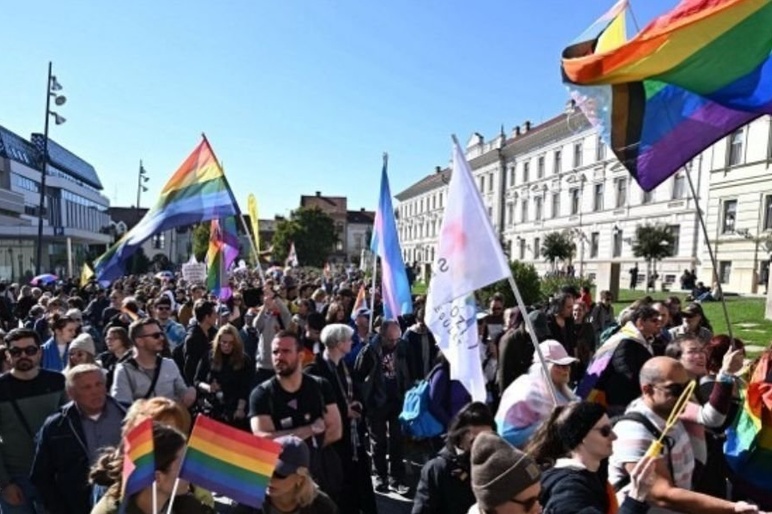
On 4 October 2025, Mr Géza Buzás-Hábel had organised the Pécs Pride march, despite an official ban issued by the police on 5 September 2025, shortly after he had duly notified the authorities of the planned assembly on 4 September 2025. This ban was upheld by Hungary’s Supreme Court on 14 September 2025. Despite the ban, the march went ahead peacefully without any incident to be reported. As a result of his long-standing cooperation with local authorities, Hungary’s only Pride march organised outside Budapest had been held peacefully on four previous occasions.
However, on 18 October 2025, Mr Buzás-Hábel was summoned by the police and interrogated as a criminal suspect for “organising a prohibited assembly”, an offence punishable by up to one year of imprisonment under the Hungarian Criminal Code. Following this interrogation, Mr Buzás-Hábel was allowed to return home.
This criminal prosecution of Mr Buzás-Hábel constitutes a worrying illustration of the continued shrinking of civic space in Hungary, particularly for those defending human rights. This criminal proceeding takes place in the context of a restrictive legal framework adopted in 2025. On 18 March 2025, the Hungarian Parliament passed legislation requiring the police to prohibit any public events that do not comply with Section 6/A of the Child Protection Act, a provision that restricts events depicting what is described as a “divergence from self-identity corresponding to sex at birth, sex change or homosexuality”. As the Council of Europe Commissioner for Human Rights, Michael O’Flaherty, said on 25 June 2025, this kind of criminalisation against LGBTQIA+ rights defenders raises serious concerns regarding the respect of fundamental rights in Hungary.
The Observatory recalls that on 17 February 2026, the Council of Europe Commissioner for Human Rightsexpressed his concern about the prosecution of Mr Buzás-Hábel. The Commissioner reminded the Hungarian authorities that organising a peaceful march is part of the right to peaceful assembly and urged them to drop the criminal charges against Mr Buzás-Habel. Similarly, on 18 November 2025, several United Nations Special Procedures mandate holders, including the Special Rapporteur on the situation of human rights defenders, addressed a formal communication to the Government of Hungary expressing concern over the criminal investigation against Mr Buzás-Hábel and legislations banning LGBTIQ-themed assemblies. In response, the Hungarian Ministry of Foreign Affairs publicly stated that: “LGBTQ propagandists should leave our children alone. We want to protect our children from gender madness”. This statement is extremely worrying as the authorities explicitly aim to stigmatise and discriminate the LGBTIQ community.
Therefore, the Observatory also recalls that Hungary is bound by its obligations under international and regional human rights law, including the European Convention on Human Rights (ECHR) and the Charter of Fundamental Rights of the European Union (CFREU), as well as the International Covenant on Civil and Political Rights (ICCPR), which guarantee the rights to freedom of expression, peaceful assembly and non-discrimination. The criminalisation of organisers of peaceful Pride marches constitutes a clear violation of these obligations and contributes to strengthening a climate of intimidation for human rights defenders.
The Observatory strongly condemns the criminal prosecution of Mr Géza Buzás-Hábel, which appears to be solely aimed at punishing him for the peaceful exercise of his fundamental rights and deterring others from engaging in legitimate human rights activities.
The Observatory urges the Hungarian authorities to immediatley drop the charges against Mr Géza Buzás-Hábel and to respect, in all circumstances, the rights to freedom of expression and peaceful assembly, as well the principle of non-discrimination, as enshrined in Articles 19 and 21 of the ICCPR, Articles 10 and 11 of the ECHR, and Articles 11, 12 and 21 of the CFREU.
Actions requested:
Please write to the authorities of Hungary asking them to:
- Guarantee in all circumstances the physical integrity and psychological well-being of Mr Géza Buzás-Hábel and all human rights defenders in Hungary;
- Immediately drop all criminal charges against Mr Géza Buzás-Hábel;
- Ensure that no human rights defender is criminalised or sanctioned for organising or participating in peaceful assemblies, including Pride marches;
- Guarantee in all circumstances the rights to freedom of expression and peaceful assembly, as enshrined in Articles 19 and 21 of the ICCPR, Articles 10 and 11 of the ECHR, and Articles 11 and 12 CFREU, and ensure full respect of the principle of non-discrimination, including on the grounds of sexual orientation, as enshrined in Article 21 of the CFREU.
Addresses
- Mr Viktor Orbán, Prime minister of Hungary, Email: miniszterelnok@me.gov.hu
- Mr Sándor Pintér, Minister of Interior of Hungary, Email: ugyfelszolgalat@bm.gov.hu
- Mr Bence Tuzson, Minister of Justice of Hungary, Email: lakossag@im.gov.hu
- Mr Péter Szijjártó, Minister of Foreign Affairs and Trade of Hungary, Email: konz@mfa.gov.hu
- H.E. Ms Zsófia Havasi, Ambassador to the Permanent Mission of Hungary to the United Nations in Geneva, Switzerland, Email : missions.gva@mfa.gov.hu
- H.E. Mr. Bálint Ódor, Ambassador to the Permanent Representation of Hungary to the European Union, Brussels, Belgium, Email: sec.beu@mfa.gov.hu
Please also write to the diplomatic missions or embassies of Hungary in your respective countries.
***
Paris-Geneva, 19 February 2026
Kindly inform us of any action undertaken quoting the code of this appeal in your reply.
The Observatory for the Protection of Human Rights Defenders (the Observatory) was created in 1997 by FIDH and the World Organisation Against Torture (OMCT). The objective of this programme is to intervene to prevent or remedy situations of repression against human rights defenders. FIDH and OMCT are both members of ProtectDefenders.eu, the European Union Human Rights Defenders Mechanism implemented by international civil society.
To contact the Observatory, call the emergency line:
• E-mail: alert@observatoryfordefenders.org
• Tel FIDH: + 33 1 43 55 25 18
• Tel OMCT: + 41 22 809 49 39