Enforced Disappearance and the Struggle for Truth in Latin America
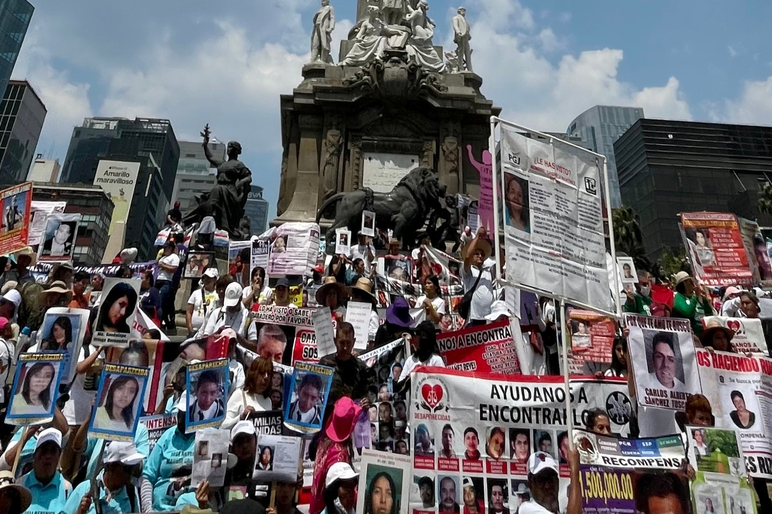
On the International Day for the Right to the Truth and for the Dignity of Victims, we focus on the struggle of victims of enforces disappearance in Latin America. Enforced disappearance, as defined by the International Convention for the Protection of All Persons from Enforced Disappearance, occurs when a person is arrested, detained, abducted, or otherwise deprived of liberty by State agents or by individuals acting with their authorisation or support, and their fate or whereabouts are concealed, depriving them of the protection of the law. This practice constitutes a grave human rights violation and may amount to torture due to the suffering inflicted on both the disappeared and their families.
In Latin America, this human rights violation has affected thousands of victims over decades. As a response, communities and movements across the region have sustained a persistent struggle for truth and justice. In 1977, in Argentina, the Abuelas de Plaza de Mayo began a search that set a milestone for the continent’s collective memory practices and marked a new chapter in the fight against enforced disappearance.
Today, enforced disappearance remains an alarming reality in the region. In Colombia, more than 100,000 victims are estimated to have been disappeared during the armed conflict between the government and the guerillas, with many cases still unresolved. In Mexico, the National Registry of Disappeared and Missing Persons reports over 130,000 disappeared, largely linked to organised crime violence and the failed security strategies in recent decades. In Argentina, the effects of the 1970s military dictatorship are still being felt, while memorialisation and justice process face denialist narratives. In Brazil, a bill to criminalise enforced disappearance was approved this year by the Lower Chamber of Parliament. In other countries, such as Venezuela and El Salvador, disappearances persist in contexts of political repression and human rights violations, including short-term disappearances used to silence human rights defenders.
Beyond the figures, each disappearance leaves behind profound suffering. Families live with the uncertainty of not knowing what happened to their loved ones. In Mexico, for nearly 13 years, Raquel Trinidad has been searching for her son, Alejandro Trinidad Escobedo, who disappeared on May 11, 2013, in Tequila, Jalisco, facing revictimisation and a lack of progress in investigations marked by repeated omissions by authorities.
In Ecuador, in December 2024, four children were detained by military personnel and subsequently disappeared and killed while in custody. On December 25th, 2024, a judge in Guayaquil declared their disappearance and initiated investigations against 16 military officers. The Constitutional Court of Ecuador issued its first ruling on enforced disappearances committed by the State, and on December 22nd, a criminal court found the officers guilty.
These stories show that enforced disappearances are not only part of the past but still an ongoing reality, and that preserving memory and demanding justice are collective responsibilities across the region.
The search for truth has become a cornerstone for families, often led by mothers, sisters, wives, and daughters, who have transformed fear and grief into resistance. These women do not only demand justice in their own cases but also push for structural changes to protect society as a whole and prevent future violations.
In this context, memory has become a powerful tool of resistance. In Mexico, madres buscadoras have created a “Recipe Book for Memory,” compiling the favorite recipes of their disappeared loved ones. In Argentina, the Abuelas de Plaza de Mayo have driven the transformation of sites where victims of the dictatorship were tortured and disappeared, such as the ESMA Memory Site Museum. In Colombia, families have worked with the National Center for Historical Memory to produce publications that reconstruct events and explain the contexts in which disappearances occurred. These efforts reaffirm that memory is a collective good, and that the right to truth belongs not only to families but to society.
In a regional context where attempts persist to deny the past and erase present violations, it is essential to guarantee access to truth, justice, and memory. Upholding these principles as a social good means placing families and their demands at the centre, and ensuring that these grave human rights violations never happen again.