Afghanistan: People’s Tribunal for Women in Afghanistan issues historic judgement.
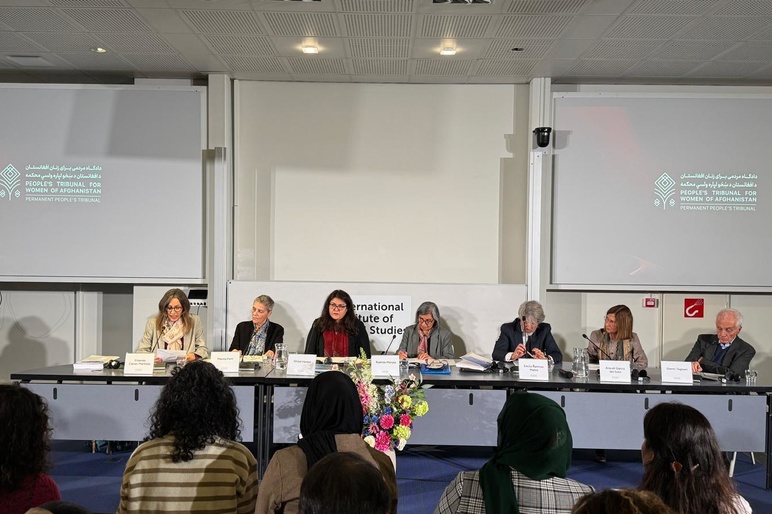
On the 11th of December 2025, the People’s Tribunal for Women in Afghanistan issued an historic judgement on the gender persecution in Afghanistan, followings hearings that were held earlier in the year.
OMCT attended this People’s Tribunal for Women in Afghanistan hearings, taking place in Madrid from the 8th to the 10th of October 2025. Considering the critical human rights situation for women and girls in the country, four human rights organisations – Rawadari, Afghanistan Human Rights and Democracy Organisation (AHRDO), Organization for Policy Research and Development Studies (DROPS) and Human Rights Defender Plus (HRD+), one of OMCT’s main partners - contacted the Permanent People’s Tribunal to request the launch of a People’s Tribunal for the women and girls in Afghanistan.
After 1981 and 1982, this was the third time that Afghanistan has been judged by the Permanent People Tribunal - an independent, bottom-up and civil society-led type of tribunal that exists as an alternative to official international courts and described by one of the prosecutors as “an alternative way to raise the voices of the victims”. Regarding the dramatic situation for women and girls in the country since the Taliban’s takeover in 2021, the tribunal focussed on the international crimes of gender persecution committed by the Taliban. As one of the prosecutors stated, the situation of women and girls in Afghanistan could be considered as “a kind of extreme oppression to which there is no comparison across the world”.
During the hearings in Madrid, in October 2025, victims and witnesses described the Taliban’s policies as a deliberate, systematic and state-cordoned violation of human-rights against women and girls. Issues such as denial of education, of civil and political rights or economic exclusion were amongst the topics raised by Afghan women and members of civil society. As a woman from Afghanistan described:
"They took everything from us, but they could not take our will".
After reviewing the situation carefully, considering the multiple testimonies and in accordance with internationally recognized legal norms, the Tribunal concluded in its judgement session on the 11th of December 2025, that:
- The Taliban’s institutionalized discrimination against women amounts to gender persecution
- The Taliban’s action in Afghanistan amount to “Other Inhumane Acts” under the Rome Statute
- The State of Afghanistan has violated the core human rights of women and girls of Afghanistan
The UN Special Rapporteur for Afghanistan emphazised that while the court is not binding as a criminal court, it is a confirmation of what women and girls in Afghanistan have endured and are enduring under the Taliban regime.
Regarding the accusations of 'gender apartheid' in Afghanistan, the prosecutors acknowledged that the situation meets the constitutive elements of an apartheid-like system. However, they noted that it could not be qualified as such since 'gender apartheid' is not codified in international law. Nevertheless, they advocated establishing 'gender apartheid' as a recognised violation of international law to fill existing gaps and enable the prosecution of crimes under these charges.
Access the full final judgement below: